Register  |  Login

Posts Tagged ‘joe menkevich’

Rare Duffield Surveyors Compass Rediscovered at the Historical Society of Frankford

Thursday, March 15th, 2012

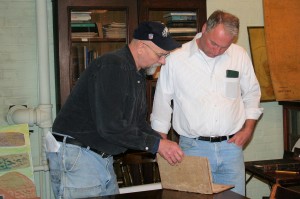
Tuesday night at the first 2012 meeting of the Historical Society of Frankford, Torben Jenk and Joe Menkevich were taking advantage of the behind the scenes tour of the building to look into the corners.  In the process, a rare 18th century Duffield Compass caught their eye.  This instrument is over 200 years old.  It has been in the collection for a long time but it takes an expert eye to see the significance of an item of that kind.  There may be a program in the fall to discuss the significance of that find.

In other news from the meeting, Jim Young, President of the Society laid out plans for further improvements to the building this year made possible by a grant.  This will include finishing up exterior gutter replacements, interior painting and upgrades to the rest room on the lower level. Young says this year the budget is balanced.

There are additions to the board which were voted on and approved at the meeting. Several new volunteers have come into the group this year who will lend valuable expertise in several areas that heretofore have been lacking.

The next meeting of the Historical Society of Frankford will be on Tuesday April 10th with a presentation by Allen Hornblum on K & A’s SECOND STORY MEN.  Allen is a great storyteller.  You won’t want to miss seeing him.

Northwood Civic Meeting 2/21/2012

Friday, February 24th, 2012

Ian Litwin - Community Planner

Frankford in 2035 was on the agenda at the Northwood Civic meeting on Tuesday with a presentation made by Ian Litwin, a community planner with the Philadelphia City Planning Commission.  Litwin explained that the lower northeast planning district will now be the focus of the planning process for Philadelphia2035.  That process will begin with a meeting at Friends Hospital on April 3rd at 6PM.  Subsequent meetings will result in a draft plan for the district in the Fall.

During each district plan, a Steering Committee will help guide the plan, facilitate information flow and review outreach efforts.  Chaired by Philadelphia City Planning Commission’s Project Manager, a Steering Committee is comprised of leaders of neighborhood groups, business groups, and institutions such as colleges or hospitals.  Steering Committees will meet on a monthly basis during a district plan.

Three public meetings in total will take place during each district plan.  Public meetings are designed to be available to all citizens in a district.  Advertised through community organizations, flyers, direct mailings and internet postings, the public meetings will update residents on the progress of the plan and seek public input.

The opportunity to have a voice in a plan that will ultimately shape the neighborhood of the future does not often come along.

In other news from the meeting, Joe Krause gave a brief treasurer’s report and announced that Renee Hudson will be acting Treasurer until at least next month.  Some records need to be sorted out and then a report for the last two years can be made public.

Joe Krause Presdent of Northwood Civic

Committees are still being formed and volunteers are needed.  Come to the civic meeting to get involved.

The illegal parking problem on Bridge Street discussed at the last meeting seems to have been resolved but members should continue to keep an eye on the situation.

Joe has made contact with the Frankford Civic to offer to work together toward common goals.

Joe Menkevich was recognized to talk about the Burk Deed restriction and offered copies of the relevant documents.  They are linked on our history page where you can download the pdf files for viewing.

One person attending was recognized and raised the issue of the poor condition of Greenwood Cemetery.  Significant improvements were made to the cemetery over the last two years but in the back over along the Castor Avenue side, it is still overgrown and people are going in there at night.  This is a link to a slide show we did in the fall that shows some of those conditions at that time.

Another resident complained about the new Northwood Academy Charter School building on Castor Avenue.  He said it looks much larger than was originally planned and looms over the neighborhood.  There are traffic concerns too in that there is no safe place for students to be picked up and discharged from the buses.  Joe Menkevich noted the presence of a vacant lot at 4601-19 Adams Avenue that might be utilized for a bus loading area.  State Rep. Tony Payton offered to pass along this information to Northwood Academy.  Joe Krause said he had a meeting scheduled with them and would bring the issue up at that time also.

Attending the meeting were our two State Representatives, John Taylor and Tony Payton.  They both spoke briefly about what is going on at the capitol and the problems of being in the legislature in this period of financial crisis.

The next meeting of the Northwood Civic Association will be on March 20th at 7PM at St. James Lutheran Church at Pratt Street and Castor Avenue.


This Day in Frankford History

Wednesday, August 31st, 2011

This is from our contributor Joe Menkevich.

August 31, 1774

Here in Frankford, the Revolution began long ago with the arrival of the Founding Fathers. The Founding Fathers stopped in Frankford before the first meeting of Continental Congress in Philadelphia took place.

The History:

There were many secret meetings held here in Frankford during the formative stages of the Declaration of Independence. A Pickering family had a seat here, and is is said (as oral history) that Jefferson was distantly related to Dr. Enoch Edwards who bought the old Summer Home from the Drinker family. Womrath park is the only thing left of that estate.

Frankfort Advice

In later years John Adams would recall the warning advice given to the Massachusetts delegation the day of their arrival for the First Congress.  Benjamin Rush, Thomas Mifflin, and two or three other Philadelphia patriots had ridden out to welcome the Massachusetts men, and at a tavern in the village of Frankford, in the seclusion of a private room, they told the New Englanders they were “suspected of having independence in view.” They were perceived to be “too zealous” and must not presume to take the lead. Virginia, they were reminded, was the largest, richest, and most populous of the colonies, and the “very proud” Virginians felt they had the right to lead.
According to Adams, the advice made a deep impression, and among the consequences was the choice of George Washington to head the army. But Adams also wrote that he had “not in my nature prudence and caution enough” always to stand back. Years before, at age twenty, he had set down in his diary that men ought to “avow their opinions and defend them with boldness.”

Excerpts from: Thomas Jefferson, July 27, 1821, Autobiography Draft Fragment, January 6 through July 27 – Library of Congress

In Congress, Friday June 7, 1776. The delegates from Virginia moved in obedience to instructions from their constituents that the Congress should declare that these United colonies are & of right ought to be free & independent states, that they are absolved from all allegiance to the British crown, and that all political connection between them & the state of Great Britain is & ought to be, totally dissolved; that measures should be immediately taken for procuring the assistance of foreign powers, and a Confederation be formed to bind the colonies more closely together….(note immediately below in quotes)
“The Congress sat till 7 o’clock this evening in consequence of a motion of R. H. Lee’s rendering ourselves free and independent States. The sensible part of the House opposed the Motion–they had no objection to forming a Scheme of a Treaty which they would send to France by proper Persons & uniting this Continent by a Confederacy; they saw no wisdom in a Declaration of Independence, nor any other Purpose to be enforced by it, but placing ourselves in the power of those with whom we mean to treat, giving our Enemy Notice of our Intentions before we had taken any steps to execute them…..” — E. Rutledge to John Jay, June 8, 1776.]

A different account is given of this by John Adams, as follows

John Adams to Timothy Pickering.
August 6, 1822
You inquire why so young a man as Mr. Jefferson was placed at the head of the committee for preparing a Declaration of Independence? I answer: It was the Frankfort advice to place Virginia at the head of everything. Mr. Richard Henry Lee might be gone to Virginia, to his sick family, for aught I know, but that was not the reason for Mr. Jefferson’s appointment. There were three committees appointed at the same time, one for the Declaration of Independence, another for preparing articles of confederation, and another for preparing a treaty to be proposed to France. Mr. Lee was chosen for the Committee of Confederation, and it was not thought convenient that the same person should be upon both. Mr. Jefferson came into Congress in June, 1775, and brought with him a reputation for literature, science, and a happy talent of composition. Writings of his were handed about, remarkable for the peculiar felicity of expression. Though a silent member in Congress, he was so prompt, frank, explicit and decisive upon committees and in conversation-not even Samuel Adams was more so-that he soon seized upon my heart; and upon this occasion I gave him my vote, and did all in my power to procure the votes of others. I think he had one more vote than any other, and that placed him at the head of the committee. I had the next highest number, and that placed me the second. The committee met, discussed the subject, and then appointed Mr. Jefferson and me to make the draught, I suppose because we were the two first on the list.
The sub-committee met. Jefferson proposed to me to make the draught. I said, “I will not.”
“You should do it.”
“Oh! no.”
“Why will you not? You ought to do it.”
“I will not.”
“Why?”
“Reason enough.”
“What can be your reasons?”
“Reason first – You are a Virginian, and a Virginian ought to appear at the head of this business. Reason second – I am obnoxious, suspected and unpopular. You are very much otherwise. Reason third – You can write ten times better than I can.”
“Well,” said Jefferson, “if you are decided, I will do as well as I can.”
“Very well. When you have drawn it up, we will have a meeting.”
A meeting we accordingly had, and conned the paper over. I was delighted with its high tone and the flights of oratory with which it abounded, especially that concerning Negro slavery, which, though I knew his Southern brethren would never suffer to pass in Congress, I certainly never would oppose. There were other expressions which I would not have inserted, if I had drawn it up, particularly that which called the King tyrant. I thought this too personal; for I never believed George to be a tyrant in disposition and in nature; I always believed him to be deceived by his courtiers on both sides of the Atlantic, and, in his official capacity only, cruel. 1 thought the expression too passionate, and too much like scolding, for so grave and solemn a document; but as Franklin and Sherman were to inspect it afterwards, I thought it would not become me to strike it out. I consented to report it, and do not now remember that I made or suggested a single
alteration.
We reported it to the committee of five. It was read, and I do not remember that Franklin or Sherman criticized any thing. We were all in haste. Congress was impatient, and the instrument was reported, as I believe, in Jefferson’s handwriting, as he first drew it. Congress cut off about a quarter of it, as I expected they would; but they obliterated some of the best of it, and left all that was exceptionable, if any thing in it was. 1 have long wondered that the original draught has not been published. I suppose the reason is the vehement philippic against Negro slavery.
As you justly observe, there is not an idea in it but what had been hackneyed in Congress for two years before. The substance of it is contained in the declaration of rights and the violation of those rights in the Journals of Congress, in 1774. Indeed, the essence of it is contained in a pamphlet, voted and printed by the town of Boston, before the first Congress met, composed by James Otis, as I suppose, in one of his lucid intervals, and pruned and polished by Samuel Adams. …”
J.M.
(Disclaimer, almost all of the above text is borrowed and only rearranged. Many other authors have written on the subject. This is just a reminder of this day in Frakford’s History.)

Greenwood Estate at Rush Farm

Tuesday, July 19th, 2011

It has taken me a while but I finally got over to the Rush house to get some current pictures to compare with what we had posted in January of 2009.  I just wanted to show how much has changed.  Interior shots are courtesy of Joe Menkevich.  Click on the small picture and you will get a popup with the larger version.  You can see there is still work to be done but the house appears to be essentially complete.  You can see that the iron work that spanned the front gate has been removed.  I hope it is out being restored.  It was unique.  The grounds are neat and tidy now although I didn’t walk all around the property.  It is actually so different now that I lost my landmark for W.C. Fields parents whose grave I stumbled over by accident when I first went in there.

There are more pictures on their web site.  Take a look via this link.


Revolutionary War Soldiers Honored at Pennepack Baptist Church

Thursday, July 14th, 2011

Joe Menkevich tipped me off to this event as it was planned so I know he was deeply involved in the research (his specialty) involved.  When I happened to find a copy of the Northeast Times I was happy to see they had given it pretty good coverage by sending Bill Kenny.  So naturally I went to the web site to find the article online and it was not listed on the web page.  Now that seemed foolish.  I used the search function and there it was hidden but certainly not in plain sight.

During last week’s Northeast History Network event, members adorned the graves of both Holme brothers, as well as six other men, with markers signifying their uniformed Revolutionary War service.

Moore and Joseph Menkevich of Northwood developed the program for the history group in cooperation with Pennepack Baptist and its cemetery caretaker, Tim Unruh.

The historical revelations came fast and furiously.

“That’s exactly the point of this whole thing, learning stuff and putting pieces together,” Moore said.

You can read the entire piece here.  The video below is the activity marking the graves.  This link will take you to another video of the activity inside the church.  Both videos courtesy of Joe Menkevich.